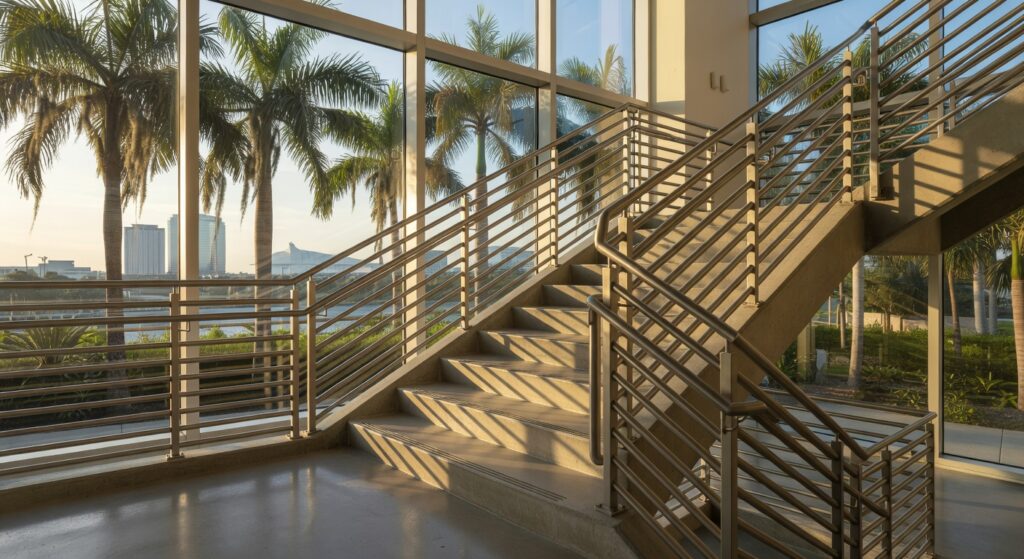
Why Handrail and Staircase Compliance Actually Matters in Tampa
You don’t want a building inspector showing up and hitting you with Florida’s commercial handrail codes for the first time.
Trust me, it’s way worse when a personal injury lawyer’s the one spelling them out.
I’ve been building and installing commercial railings and staircases around Tampa Bay for over twenty years, and here’s what I’ve learned — code compliance issues come up way more often than most building owners realize.
Walk around older commercial spots in Ybor City, Channelside, or Seminole Heights and you’ll see it constantly.
When that Surfside condo collapsed in 2021, Florida didn’t mess around — they ramped up structural inspections for every commercial and multi-story building practically overnight.
But they didn’t stop there with the crackdown.
Florida Building Code: The Baseline for Staircase Compliance in Tampa
The 2023 Florida Building Code (FBC) governs commercial staircase design and is based on the International Building Code (IBC) — but with important Florida-specific additions. Understanding both layers is critical if you want to stay compliant.
Stair Dimension Requirements
Here are the hard numbers the FBC requires for commercial stairs:
- Minimum tread depth: 11 inches (the horizontal surface you step on)
- Maximum riser height: 7 inches (the vertical face between treads) — some provisions allow up to 7¾ inches in specific occupancy types
- Minimum stair width: 44 inches for most commercial occupancies; 36 inches if serving fewer than 50 occupants
- Maximum vertical rise per flight: 12 feet 7 inches before a landing is required
- Minimum headroom clearance: 80 inches, measured vertically from the leading edge of each tread
That headroom requirement catches a lot of building owners off guard during renovations. I’ve been called out to properties in Hyde Park and South Tampa where a dropped ceiling or new HVAC ductwork was installed without anyone checking the 80-inch clearance above the stair. That’s an immediate violation.
Handrail Height and Positioning
Under the FBC, commercial handrails must be installed on both sides of any stairway and positioned between 34 and 38 inches above the stair tread nosing (the front edge of each step). The handrail cannot protrude more than 4.5 inches into the required stair width on either side.
I see single-sided handrails constantly in older commercial buildings — particularly in Ybor City’s historic brick structures and some of the converted warehouses in Channelside. A single handrail might have been acceptable under older codes, but if you’ve done any renovation work that triggers a permit, you’re required to bring the entire stairway up to current standards.
💡 Pro Tip: If you’re unsure whether your existing handrails meet current height requirements, grab a tape measure and check from the tread nosing — not the tread surface — to the top of the rail. That distinction matters. If you’re coming up short or running over 38 inches, our team can assess your commercial railing system and bring it into compliance without a full replacement in many cases.
ADA Handrail Requirements: The Layer Most Building Owners Miss
The Florida Building Code sets the structural baseline, but ADA handrail requirements add another layer of specifications that apply to virtually every commercial building open to the public. These two sets of rules overlap in most areas but diverge in ways that matter.
Graspability: The Detail That Gets Buildings Cited
ADA standards require handrails to be graspable — meaning a person must be able to wrap their hand around the rail and maintain a continuous grip from top to bottom. The ADA specifies two acceptable cross-section types:
- Type I (circular cross-section): Outer diameter between 1¼ and 2 inches
- Type II (non-circular cross-section): Perimeter between 4 and 6¼ inches, with a maximum cross-section dimension of 2¼ inches
This is where I see a lot of problems in Davis Islands medical offices and Westshore business district buildings — flat-top or wide decorative rails that look great but don’t meet graspability standards. A rail that’s too wide or too flat can’t be properly gripped in an emergency, and the ADA takes that seriously.
Handrail Extensions: Required, Not Optional
One of the most commonly missed ADA requirements is the handrail extension mandate. At the top of a stairway, the handrail must extend horizontally at least 12 inches beyond the top riser. At the bottom, the rail must extend one full tread depth beyond the bottom riser, then slope down to a point 12 inches below the bottom nosing height before terminating.
These extensions exist so that people with mobility challenges can stabilize themselves before stepping onto the first or last tread. I’ve inspected dozens of commercial properties in Palma Ceia and around Bayshore Boulevard where the rails just stop at the top and bottom step — no extensions at all. That’s a clear ADA violation and a genuine safety hazard.
Accessible Means of Egress Width
If a stairway serves as an accessible means of egress — which is required in most multi-story commercial buildings — the clear width between handrails must be at least 48 inches. The exception applies if the building is fully sprinkler-protected or if an area of refuge is provided on each floor.
⚠️ Warning: ADA violations in commercial buildings aren’t just a code issue — they’re a federal liability exposure. Unlike building code violations that are typically addressed during inspections, ADA non-compliance can be the basis of a civil lawsuit filed directly by any individual who encounters the barrier. If your staircase was built before 1992 and has never been updated, assume there are ADA issues and get a professional assessment now.
Tampa’s Coastal Environment: Why Standard Specs Aren’t Enough
Here’s something the code books don’t emphasize enough for Tampa Bay building owners: our coastal environment accelerates material failure in ways that inland markets don’t experience. Salt air, high humidity, and the occasional direct hurricane hit create conditions that will destroy an improperly specified handrail system years before its design life.
The Florida Building Code requires that stair and handrail anchorage systems meet Miami-Dade Notice of Acceptance (NOA) testing for wind pressure resistance. But beyond the structural wind requirements, material selection is critical. I’ve written about this in detail in our post on the best materials for outdoor railings in Florida’s salt air and humidity, but the short version is:
- 316 stainless steel is the gold standard for coastal commercial applications — superior corrosion resistance compared to the more common 304 grade
- Hot-dip galvanized carbon steel is a cost-effective option for interior commercial stairs with adequate coating thickness (typically 3.9 mils minimum)
- Powder-coated carbon steel can work for interior applications but requires regular inspection and touch-up in our climate
- Aluminum works well for weight-sensitive applications but requires proper alloy selection and anodizing for coastal exposure
Welded connections are particularly vulnerable. If the weld area isn’t properly treated and coated, you’ll see rust bleeding through within a year or two on exterior applications near the bay. Our commercial welding services always include proper post-weld treatment and coating specifications matched to the installation environment.
💡 Pro Tip: After any significant storm, do a hands-on inspection of all exterior stair and handrail connections — not just a visual check. Grab the rail and try to move it. Any play or movement in the anchoring system means the connection has been compromised and needs immediate attention. Our post-storm welding inspection checklist walks you through exactly what to look for.
The Most Common Violations I Find in Tampa Commercial Buildings
After two decades of working on commercial properties across Tampa Bay — from the historic buildings in Ybor City to the newer mixed-use developments in Channelside — I’ve developed a pretty clear picture of where buildings consistently fail. Here are the violations I find most often:
1. Inconsistent Riser Heights Within a Single Flight
This is the big one. Both the FBC and ADA require that all risers within a single flight of stairs be uniform in height — the tolerance is just 3/8 of an inch between the tallest and shortest riser. In older buildings, settling, previous repairs, or amateur renovation work often creates variation that exceeds this tolerance. It’s a tripping hazard and an immediate code violation.
I recently worked on a three-story office building near Westshore where a previous contractor had patched some damaged treads with mortar fill. The riser heights varied by nearly three-quarters of an inch across one flight. The building had been operating like that for years before a tenant complained and the owner called us in.
2. Handrails That Can’t Be Gripped
Decorative flat-top rails, wide box-section rails, and ornamental designs that look impressive in a lobby often fail the ADA graspability test. I see this constantly in renovated historic buildings in Hyde Park and South Tampa where someone prioritized aesthetics over compliance. The fix usually involves adding a graspable inner rail — not necessarily replacing the entire system.
3. Missing or Incorrect Handrail Extensions
As I mentioned earlier, the top and bottom extensions are almost universally missing in pre-2000 commercial construction. This is a straightforward fix for our team — we can field-fabricate and weld extension pieces to match the existing rail profile. Typical cost for this type of repair runs $300–$700 per staircase end, depending on rail profile complexity and material.
4. Corroded or Loose Anchor Points
This is the one that keeps me up at night from a safety standpoint. A handrail that looks fine visually can have completely compromised anchor points beneath the surface — especially in older concrete construction where the anchor bolts have been corroding for decades. The FBC requires handrails to resist a 200-pound concentrated load in any direction. A corroded anchor system often can’t come close to that.
5. Inadequate Stair Width After Renovation
I’ve seen commercial properties in Seminole Heights and Palma Ceia where tenant improvement work — new walls, added storage, relocated equipment — inadvertently narrowed a stairway below the 44-inch minimum. If the handrails were then moved inward to accommodate, you’ve got a double violation. This one requires a more significant structural solution, but it’s not optional.
⚠️ Warning: Post-Surfside, the City of Tampa and Hillsborough County have increased scrutiny on structural inspections for buildings three stories and taller. If your building is due for a milestone inspection under Florida’s new Condominium and Cooperative Safety Act, stairway and handrail systems will be part of that review. Don’t wait for the inspector to find the violations — address them proactively.
What a Commercial Handrail Compliance Project Actually Costs in Tampa
I know building owners want real numbers, so here’s an honest breakdown of what compliance work typically runs in our market:
- Handrail height adjustment (existing rail repositioning): $400–$900 per flight, depending on mounting type and access
- Adding a second handrail to a single-sided stair: $800–$2,500 per flight for fabrication and installation
- Handrail extension additions (top and bottom): $300–$700 per end
- Full handrail replacement — commercial grade, both sides: $2,500–$8,000 per flight depending on material, length, and complexity
- Anchor point repair/replacement: $150–$400 per post, more if concrete core drilling is required
- Full commercial staircase replacement (steel pan, new rails): $15,000–$45,000+ depending on size and configuration
Most compliance projects I work on fall in the $2,000–$10,000 range — significant, but a fraction of what a single ADA lawsuit or building citation can cost. Our complete Tampa welding repair cost guide has more detail on pricing factors if you want to dig deeper.
For buildings with complex architectural requirements — think spiral staircases in a Ybor City restaurant or a curved staircase in a Davis Islands office building — our custom spiral staircase fabrication and commercial railing services can address compliance while maintaining the aesthetic character of the space.
Frequently Asked Questions: Commercial Handrail Code in Florida
What height do commercial handrails need to be in Florida?
Under the 2023 Florida Building Code, commercial handrails must be installed between 34 and 38 inches above the stair tread nosing (the leading edge of each step). This measurement is taken vertically from the nosing to the top of the gripping surface of the rail.
Are handrails required on both sides of commercial stairs in Florida?
Yes. The Florida Building Code requires handrails on both sides of commercial stairways. Single-sided handrails may have been acceptable under older codes, but any permitted renovation work triggers a requirement to bring the full stairway up to current standards.
What are the ADA handrail extension requirements for commercial stairs?
ADA standards require handrails to extend at least 12 inches horizontally beyond the top riser at the top of the stair. At the bottom, the rail must extend one full tread depth past the bottom riser, then slope down and continue horizontally for 12 inches before terminating. Extensions must return to a wall or post — they cannot create a protruding hazard.
What diameter does an ADA-compliant handrail need to be?
For circular cross-section rails (the most common type), ADA requires an outer diameter of 1¼ to 2 inches. Non-circular profiles must have a perimeter between 4 and 6¼ inches with a maximum cross-section dimension of 2¼ inches. The key requirement is that the rail must be fully graspable — a person must be able to wrap their hand around it.
How do post-Surfside inspection requirements affect Tampa commercial building owners?
Florida’s updated building safety laws require milestone structural inspections for buildings three stories or taller at 30 years of age (25 years if within three miles of the coast), and every 10 years thereafter. These inspections cover structural systems including stairways and egress paths. Buildings that fail inspection must complete repairs before receiving recertification. Staircase and handrail deficiencies identified during these inspections must be corrected — proactive compliance is far less disruptive than emergency repair under inspection deadlines.
Get Your Tampa Commercial Staircase Into Compliance
If you’ve read through this post and you’re not 100% certain your commercial stairways meet current Florida Building Code and ADA requirements, the next step is a professional assessment. Our team at E2E Welding has performed compliance evaluations and remediation work on commercial properties throughout the Tampa Bay area — from small retail spaces in Seminole Heights to multi-story office buildings in the Westshore business district.
We’re not just welders — we understand the code requirements, we work with permit offices, and we can document our work for your inspection records. Whether you need a minor handrail adjustment or a complete staircase fabrication and installation, we do it right the first time.
Contact E2E Welding today to schedule a commercial staircase compliance assessment. We’ll walk your property, identify any issues, and give you a clear, itemized proposal for bringing everything up to code — no surprises.
E2E Welding provides professional commercial staircase fabrication, handrail installation, and code compliance services across the Tampa Bay area — Tampa, St. Petersburg, Clearwater, Brandon, Wesley Chapel, Riverview, and surrounding communities. Call us or use our online contact form to get started.