Why Your Railing Material Choice Is a Bigger Deal in Florida Than Anywhere Else
I’ve been fabricating and installing outdoor railings across Tampa Bay for over two decades, and I’ll tell you straight: choosing the wrong outdoor railing material in Florida isn’t just an aesthetic mistake — it’s an expensive one. The combination of salt air, year-round humidity, UV radiation, and hurricane-force winds creates one of the harshest environments for metal on the planet.
I’ve pulled out railings on Davis Islands and Bayshore Boulevard that were less than five years old, completely eaten through by corrosion. The homeowners thought they were getting a deal. They weren’t. When you’re evaluating outdoor railing materials for Florida properties — especially anything within a mile or two of Tampa Bay or the Gulf — you need to think long-term from day one.
In this post, I’m going to walk you through every major material option, give you real cost numbers from projects we’ve done right here in the Tampa Bay area, and tell you exactly what I’d recommend based on your property’s location and budget.
What Florida’s Climate Actually Does to Metal Railings
Tampa Bay’s average annual humidity runs between 75–85%. We get 90+ inches of rain per year. And if your property is within a couple miles of the water — think Channelside, Hyde Park, Palma Ceia, or anywhere along Bayshore — you’re also dealing with salt-laden air that accelerates metal corrosion up to 10 times faster than inland environments.
Here’s the science in plain terms: salt particles in the air combine with moisture to form an electrolytic solution that sits on your metal surfaces. That solution acts like a battery, pulling electrons out of the metal and breaking it down from the outside in. Tampa Bay’s salinity averages 25–30 parts per thousand, and during summer storm season, salt deposition on exposed metal surfaces spikes significantly.
On top of that, Florida Building Code (FBC 2023, 8th Edition) mandates corrosion-resistant materials for exterior railings in high-velocity hurricane zones, and Tampa’s coastal areas absolutely qualify. Your railings need to handle sustained winds of 150–180 mph in a Category 4 event. That’s not a suggestion — it’s a code requirement that affects what materials and fasteners you can legally use.
⚠️ Warning: A 2024 coastal construction report found that 40% of railing failures on Gulf Coast homes stem from corrosion on non-resistant metals. If your current railings are standard carbon steel or untreated wrought iron and they’re within two miles of the water, have them inspected now. Corroded railings are a fall hazard and a code violation. See our post on 5 signs your Tampa property needs professional welding repairs to know what to look for.
The Main Outdoor Railing Materials for Florida: A Straight-Up Comparison
1. Powder-Coated Aluminum — My Go-To for Most Tampa Bay Properties
If I had to pick one material for the widest range of Florida waterfront applications, it’s powder-coated aluminum. Aluminum doesn’t rust — period. It forms a natural oxide layer that actually protects it from further corrosion, and when you add a quality powder coat finish on top, you’re looking at a railing system that can last 50+ years in our climate with minimal maintenance.
We installed powder-coated aluminum railings on a waterfront condo project in Channelside about eight years ago — roughly 400 linear feet of custom work. Those railings still look nearly brand new. The powder coat has held up through multiple hurricane seasons without cracking, fading, or peeling.
Cost in Tampa Bay (2024–2025): $50–90 per linear foot installed. Materials run $30–50 per foot, labor $20–40. For a typical 60-foot deck railing project, you’re looking at $3,000–$5,400 total.
- Pros: Naturally corrosion-resistant, lightweight, low maintenance, FBC-compliant, wide design flexibility, 50+ year lifespan in Florida conditions
- Cons: Can dent more easily than steel, not ideal for extremely high-traffic commercial applications that see heavy physical abuse
- Best for: Residential decks, balconies, pool enclosures, waterfront properties in South Tampa, Davis Islands, Palma Ceia
💡 Pro Tip: When specifying powder coat for a coastal Florida property, ask for a two-stage process — a zinc phosphate primer layer followed by the topcoat. This adds a corrosion barrier that dramatically extends coating life in salt air environments. Most budget installers skip the primer stage. We don’t. Check out our portfolio to see examples of our aluminum railing finishes.
2. 316 Marine-Grade Stainless Steel — The Premium Choice for Serious Waterfront Exposure
When a client on Davis Islands tells me their dock-side railing needs to look sharp and survive direct salt spray year after year, I spec 316 stainless steel. The “316” designation means it contains molybdenum, which gives it dramatically better resistance to chloride corrosion compared to the more common 304 grade.
In standardized salt spray testing, 316 stainless shows less than 1% corrosion after 1,000 hours of exposure. Carbon steel? Over 50% in the same test. That’s not a small difference — that’s the difference between a 40-year railing and one that’s failing in three years.
Cost in Tampa Bay (2024–2025): $80–150 per linear foot installed. Materials run $50–90 per foot, labor $30–60. A 60-foot project runs $4,800–$9,000. Yes, it costs more upfront — but over a 40–60 year lifespan, the math works out.
- Pros: Exceptional corrosion resistance, premium aesthetic, extremely strong, minimal maintenance, ideal for direct marine exposure
- Cons: Higher upfront cost, requires proper passivation after welding to maintain corrosion resistance, heavier than aluminum
- Best for: Docks, direct waterfront applications, luxury properties, commercial projects in Westshore and Channelside
⚠️ Warning: Never mix 316 stainless steel with carbon steel or galvanized components without using isolation washers and non-conductive separators. When dissimilar metals contact each other in a salt-air environment, galvanic corrosion accelerates dramatically — the Florida Building Code (FBC Section R317.3) actually requires galvanic corrosion prevention when mixing metals. I’ve seen brand-new stainless railings develop rust staining within months because someone used the wrong fasteners.
3. Wrought Iron — Beautiful, But High-Maintenance in Florida
Wrought iron railings are gorgeous. The craftsmanship, the weight, the classic look — I genuinely love working with this material. We’ve done some stunning wrought iron work on historic properties in Ybor City and Seminole Heights. But I’ll be straight with you: in Florida’s coastal climate, wrought iron demands serious commitment to maintenance.
Unprotected iron in Tampa Bay humidity will begin surface rusting within months. The key is a proper coating system: a rust-inhibiting primer, a quality topcoat, and ideally a marine-grade paint finish. Even then, plan on touching up the finish every 3–5 years and doing a full strip-and-repaint every 10–15 years.
For inland Tampa properties — Seminole Heights, Hyde Park, areas away from direct bay exposure — wrought iron is a perfectly viable choice if you’re willing to maintain it. For anything within a mile of the water, I’d steer most clients toward aluminum or stainless instead.
4. Galvanized Steel — Budget Option With Caveats
Hot-dip galvanizing — where steel is submerged in molten zinc — creates a sacrificial coating that protects the underlying steel from corrosion. It’s a legitimate process and works well in many environments. In Tampa Bay’s salt air? It’s a shorter-term solution.
Galvanized steel railings in coastal Florida typically last 10–20 years with maintenance, but you’ll start seeing pitting within 5–10 years without regular attention. Budget $40–70 per linear foot installed, but factor in recoating costs of $10–20 per foot every five years or so. Over 20 years, that “cheaper” option often costs more than aluminum.
I use galvanized components regularly — particularly for structural elements, posts, and fasteners where the FBC requires it (G90 hot-dipped galvanized per Section R317.3). But as a primary railing material on a waterfront property, I’d only recommend it as a budget-driven compromise with eyes wide open about the maintenance commitment.
5. Cable Railings — Modern Look, Specific Maintenance Needs
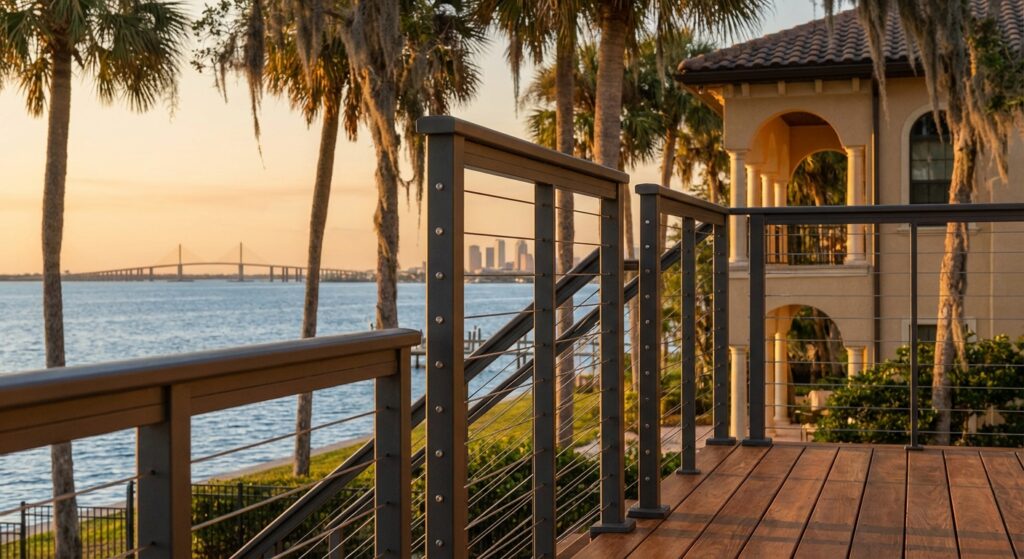
Cable railings have exploded in popularity over the last decade, and honestly, I get it — they look fantastic on modern waterfront homes and they don’t block your view of Tampa Bay. The cable itself should always be 316 stainless for Florida applications. The posts are typically powder-coated aluminum or 316 stainless as well.
The maintenance consideration with cable systems is tension. Florida’s temperature swings — even though they’re not as dramatic as northern states — cause metal to expand and contract. Cable tension needs to be checked annually and adjusted as needed. We’ve done cable railing installations on several properties along Bayshore Boulevard, and the clients who stay on top of annual tension checks have systems that look perfect years later.
Expect to pay $90–140 per linear foot installed for a quality 316 stainless cable system with aluminum posts. The premium is worth it for the aesthetic payoff on the right property.
💡 Pro Tip: Florida Building Code requires that railing openings — including cable spacing — not exceed 4 inches. This is a safety requirement to prevent children from slipping through. For cable systems, this means cables must be tensioned tight enough to maintain that 4-inch maximum gap under load. A cable that can be pushed out to 4.5 inches is a code violation, not just a tension issue. Always have cable railings inspected by a licensed contractor familiar with FBC requirements. Learn more about our railing fabrication and installation services.
Coating Systems: The Difference Between 5 Years and 50 Years
The base material matters, but the coating system is what actually stands between your railing and Florida’s climate. Here’s how the main options stack up.
Powder Coating
Electrostatically applied dry powder that’s cured in an oven. Creates a uniform, extremely durable finish that resists chipping, fading, and moisture penetration. For Florida applications, specify a TGIC polyester powder coat with a minimum 3–4 mil thickness. Quality powder coat on aluminum retains 95% structural integrity after 20 years in South Florida humidity — that’s not marketing language, that’s documented performance data.
Hot-Dip Galvanizing
Best used as a base protection layer on steel structural components, not as a standalone finish coating on visible railing elements in coastal Florida. The zinc coating provides sacrificial protection — it corrodes before the steel does — but in high-salt environments, that sacrifice happens faster than you’d like.
Marine-Grade Paint Systems
For wrought iron and steel railings, a proper marine-grade paint system is non-negotiable in Tampa Bay. This means: surface preparation to bare metal, a zinc-rich epoxy primer, an epoxy intermediate coat, and a polyurethane topcoat. Products like Sherwin-Williams marine coatings or Interlux marine paint systems are what I’d specify for iron work near the water. Skip any of those steps and you’re cutting the coating life in half.
Quick Reference: Material Comparison for Tampa Bay Properties
Here’s how the main options compare side by side for Florida coastal applications:
- Powder-Coated Aluminum: $50–90/ft installed | 50+ year lifespan | Best overall value for most Florida properties
- 316 Stainless Steel: $80–150/ft installed | 40–60 year lifespan | Best for direct marine/waterfront exposure
- Cable (316 SS + Aluminum): $90–140/ft installed | 30–50 year lifespan | Best for modern aesthetics with water views
- Galvanized Steel: $40–70/ft installed | 10–20 years with maintenance | Budget option for non-waterfront applications
- Wrought Iron: Varies widely | 20–40 years with proper maintenance | Best for historic/decorative inland applications
💡 Pro Tip: On projects over 100 linear feet, we’re typically able to offer 10–15% material cost savings through bulk purchasing. If you’re doing a large deck, multi-story balcony, or commercial property railing project in the Westshore business district or along Bayshore, get your quote for the full scope upfront — it almost always pencils out better than phasing the work. See our commercial welding services for large-scale projects.
Real Tampa Bay Project Examples
A homeowner in Palma Ceia came to us after their builder-grade galvanized steel railings developed heavy rust staining within four years of installation. We removed the old system, fabricated custom powder-coated aluminum railings with a bronze finish, and installed them with 316 stainless fasteners and neoprene isolators at every contact point. That was six years ago — the system looks exactly like it did on install day.
On a commercial renovation project in Westshore, we specified 316 stainless steel horizontal railings with tempered glass infill panels — about 180 linear feet total. The client wanted zero maintenance and a premium look that would hold up to heavy foot traffic and the salt air coming off the bay. We’re three years in and the property manager hasn’t had a single service call on those railings.
And on a historic renovation in Ybor City, we restored original wrought iron railings using a proper marine-grade coating system — zinc epoxy primer, epoxy mid-coat, polyurethane topcoat — and fabricated matching replacement sections where the originals were beyond saving. Maintaining the historic character while upgrading the corrosion protection was the right call for that property. You can see examples of work like this in our project portfolio.
Installation Details That Make or Break Longevity
Even the best material fails early if it’s installed wrong. A few things I always insist on for Florida coastal railing installations:
- Elevate posts 1–2 inches off horizontal surfaces — standing water and capillary wicking destroy coatings from the bottom up faster than anything else
- Use 316 stainless or hot-dipped G90 galvanized fasteners exclusively — FBC Section R317.3 requires it, and it’s the right call regardless
- Install galvanic isolators wherever dissimilar metals contact each other — neoprene washers, HDPE spacers, or anti-corrosion tape at every connection point
- Ensure all welds comply with AWS D1.1 structural welding standards — weld quality directly affects structural integrity under hurricane wind loads
- Passivate stainless steel welds — welding stainless disrupts the passive oxide layer; citric acid passivation restores it and prevents weld-area corrosion
If your installer isn’t talking about these details, that’s a red flag. Our post on how to choose the right welding company in Tampa covers what questions to ask before you sign any contract.
Frequently Asked Questions: Outdoor Railing Materials in Florida
What is the best metal for railings near the ocean in Florida?
For direct ocean or bay-front exposure, 316 marine-grade stainless steel is the top performer. It contains molybdenum, which provides superior resistance to chloride corrosion — the specific type of corrosion driven by salt air. For properties that aren’t in direct spray zones, powder-coated aluminum offers an excellent balance of corrosion resistance, longevity, and cost-effectiveness.
How long do aluminum railings last in Florida’s humidity?
Quality powder-coated aluminum railings installed correctly can last 50+ years in Florida’s climate. Aluminum doesn’t rust, and a properly applied powder coat finish resists UV degradation, moisture, and salt air extremely well. Studies on South Florida installations show powder-coated aluminum retaining 95% structural integrity after 20 years.
Are wrought iron railings a good choice in Tampa Bay?
Wrought iron can work in Tampa Bay, but it requires a serious maintenance commitment — proper marine-grade coating system at installation, touch-ups every 3–5 years, and full repaints every 10–15 years. For properties more than a mile from the water (Seminole Heights, inland Hyde Park), it’s a viable choice. For waterfront properties in areas like Davis Islands or Bayshore, I’d typically recommend aluminum or stainless steel instead.
What do corrosion-resistant railings cost in Tampa?
Based on current 2024–2025 Tampa Bay pricing: powder-coated aluminum runs $50–90 per linear foot installed; 316 stainless steel runs $80–150 per linear foot; cable railing systems (316 SS with aluminum posts) run $90–140 per linear foot. Galvanized steel is cheaper upfront at $40–70 per foot, but ongoing maintenance costs close that gap significantly over time.
Does Florida Building Code require specific railing materials for coastal properties?
Yes. The Florida Building Code (FBC 2023, 8th Edition) mandates corrosion-resistant materials for exterior railings in high-velocity hurricane zones, which includes Tampa’s coastal areas. Railings must withstand wind loads per ASCE 7-22 standards, and fasteners must be hot-dipped galvanized G90 or 316 stainless steel. Railing openings cannot exceed 4 inches, and railings must be a minimum 42 inches in height per FBC Section R312. Always work with a contractor who knows these requirements — contact us if you need guidance on code compliance for your project.
Ready to Get the Right Railing for Your Tampa Bay Property?
After 20+ years of fabricating and installing railings across Tampa Bay, I’ve seen what works and what fails in Florida’s unforgiving climate. The right material choice, combined with proper installation and coating systems, is the difference between a railing that looks great for decades and one you’re replacing in five years.
Whether you’re on the waterfront in Davis Islands, renovating a historic property in Ybor City, or building new in South Tampa, we can help you choose the right material and fabricate something that will genuinely last. For a detailed cost breakdown, check out our complete welding cost guide for Tampa.
Contact E2E Welding today for a free consultation and quote on your railing project. We’ll come out, assess your property, and give you a straight answer on what material makes sense for your specific location, budget, and goals — no upsell, no runaround.
E2E Welding provides professional railing fabrication and installation across the Tampa Bay area — Tampa, St. Petersburg, Clearwater, Brandon, Wesley Chapel, Riverview, and surrounding communities. Reach out today to get started.