I’ve been welding in the Tampa Bay area for over 20 years. Started out running beads on structural steel in Hillsborough County, worked my way through every kind of residential and commercial project you can think of — custom gates in South Tampa, spiral staircases in Clearwater Beach condos, hurricane-rated railings from Brandon to Wesley Chapel.
In that time, I’ve seen homeowners and business owners get burned by the wrong welding company more times than I can count. Bad welds hidden under paint. Unlicensed guys working without permits. Railings that looked fine for six months, then crumbled because nobody accounted for Tampa’s salt air and humidity.
Here’s what I’d tell a friend who asked me how to pick a welding company in Tampa — the real stuff, from someone who’s been on both sides of the handshake.
Why Picking the Right Welding Company Matters More in Tampa
Tampa isn’t Phoenix. It’s not Denver. The combination of salt air, 90% humidity half the year, hurricane season from June through November, and Florida’s strict building codes makes welding here a different game entirely.
A welding company that does solid work in a dry, inland climate might produce welds that fail within two years in Tampa Bay. Corrosion is the constant enemy. The salt air rolling off Tampa Bay and the Gulf eats through unprotected steel like acid. I’ve pulled out railings on Bayshore Boulevard that were installed just three years prior — completely compromised at the base because the welder didn’t prep the metal or apply the right protective coating.
Florida Building Code (FBC 7th Edition, based on the International Building Code with Florida-specific wind load requirements) demands hurricane-rated construction for anything structural. That’s not optional. A welding contractor who doesn’t understand wind load calculations, Miami-Dade NOA requirements for coastal installations, or the specific code requirements for Hillsborough, Pinellas, or Pasco counties is a liability waiting to happen.
What to Look For in a Tampa Welding Company
Proper Licensing and Insurance
Florida doesn’t require a specific “welding license” the way it does for electricians or plumbers. That’s actually a problem — it means anyone with a welder and a truck can call themselves a welding company.
What you want to verify:
- General contractor’s license or specialty contractor’s license if the work is structural
- Liability insurance — minimum $1 million. Ask for the certificate. A legit welding company will hand it over without hesitation.
- Workers’ compensation coverage — if they have employees. Without it, YOU could be liable if someone gets hurt on your property.
- City and county permits — any structural welding work in Tampa requires a building permit. If someone tells you “we don’t need a permit for that,” walk away.
I pulled a permit for every structural job I’ve ever done in Hillsborough County. It’s not just paperwork — the inspector checks the welds. That’s your safety net.
💡 Pro Tip: Verify any Florida contractor’s license through the Florida DBPR (Department of Business and Professional Regulation) website. It’s free and takes two minutes. If they can’t give you a license number, that tells you everything.
Florida Code Knowledge
This is where I see the biggest gap between Tampa welding companies that know what they’re doing and ones that don’t.
Ask your welding contractor these questions:
- “What’s the wind load requirement for my area?” Tampa Bay falls under a 130-150 mph wind speed zone depending on exact location. Any railing, gate, or structural weld needs to handle that.
- “What material do you recommend for my project?” In Tampa, the answer is almost always aluminum or stainless steel for exterior work — or galvanized/powder-coated carbon steel at minimum. If someone suggests raw mild steel for an outdoor railing in Tampa, they don’t understand this climate.
- “How do you handle corrosion protection?” The right answer involves surface prep (grinding, sandblasting), primer, and either powder coating or marine-grade paint. Hot-dip galvanizing for structural steel. Anything less and you’re replacing it in 5 years.
Experience with Your Specific Project Type
Welding is not one skill. It’s dozens. The guy who does great structural steel beams for a commercial warehouse may not be the right choice for a decorative spiral staircase in your home.
Ask about experience with your specific project:
- Gates and fences — Do they understand motor/actuator mounting for automated gates? Proper hinge welding for heavy driveway gates? Learn more about our custom gates →
- Railings and handrails — Do they know Florida code requirements for railing height (42″ for commercial, 36″ for residential), baluster spacing (4″ max), and graspability standards? See our railing work →
- Structural steel — Are they certified for structural welding (AWS D1.1)? Can they read engineered drawings?
- Spiral staircases — Have they actually built them? These are complex geometry. I’ve rebuilt more botched spiral staircases than I’d like to admit — usually from companies that had never fabricated one before. View our spiral staircase projects →
Portfolio and References
Any welding company worth hiring in Tampa should have a portfolio of completed projects. Photos, addresses, references.
When I finish a project — whether it’s a custom iron gate in Channelside or a commercial railing installation in Westshore — I document it. Before and after. Close-ups of the welds. Shots of the finished installation. That’s not bragging; that’s proof. View our project portfolio →
Call the references. Drive by the work if it’s visible from the street. Look at the welds if you can — they should be consistent, clean, with no visible porosity, undercut, or spatter.
Mobile Welding vs. Shop Welding: What Tampa Projects Need
Here’s something most homeowners don’t think about: where the welding happens matters as much as who does it.
Shop welding means the piece is fabricated at a shop and brought to your property for installation. Good for: gates, railings, decorative pieces that can be built to measurements and transported.
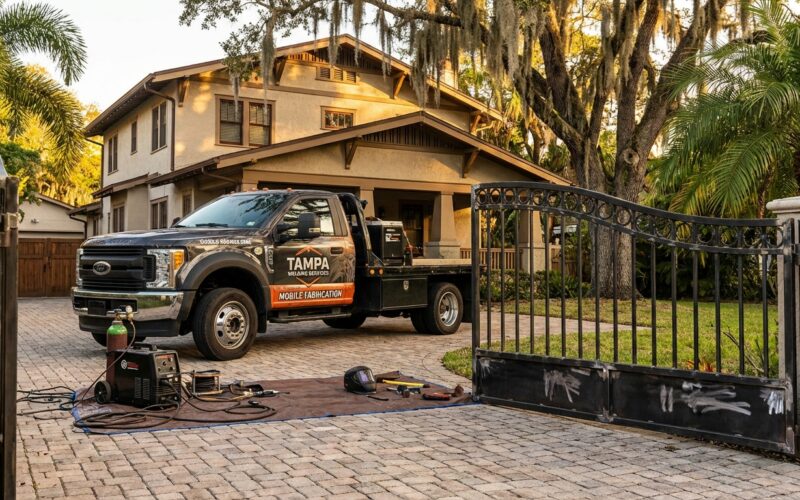
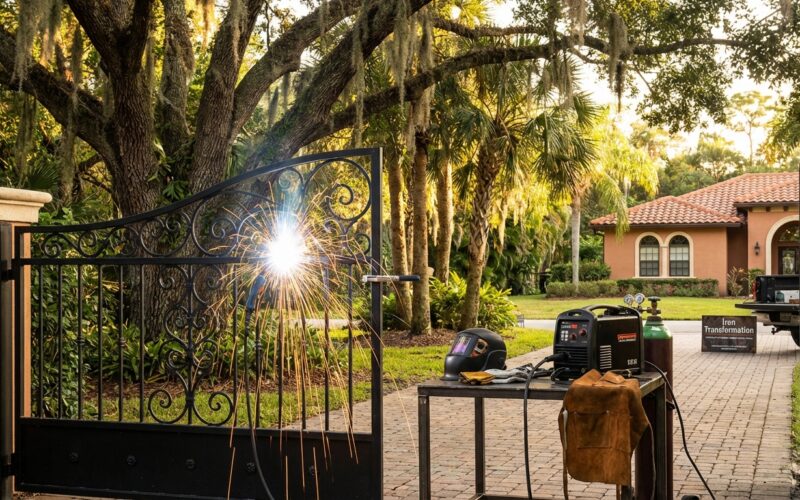
Mobile welding means the welder comes to your property with a truck-mounted rig and does the work on-site. Essential for: structural repairs, on-site modifications, anything too large to transport, emergency repairs.
In Tampa, mobile welding is often the smarter choice for residential work. Here’s why:
I did a railing replacement on a second-floor balcony in Hyde Park last year. The old railing was corroded at the anchor points — you couldn’t safely remove it without an on-site welder ready to secure the new one immediately. No way to pre-fab that in a shop. We had to measure, cut, weld, and finish everything right there.
Mobile welding also means fewer scheduling headaches. No waiting for shop time, no transportation logistics, no dealing with access issues for oversized fabrications. The welder shows up, assesses the situation, and gets to work.
💡 Pro Tip: Mobile welding requires more skill than shop work. You’re working in real conditions — wind, weather, awkward positions, limited power. Not every welder can produce shop-quality work in the field. Make sure your mobile welding company has the experience and equipment to handle on-site conditions.
Red Flags to Watch For
Twenty years of welding in Tampa has taught me what the bad operators look like. Here’s what should make you walk away:
⚠️ Warning: Red Flags That Should Make You Walk Away
- No written estimate. A verbal quote means nothing. Every legitimate welding company in Tampa provides a detailed written estimate — materials, labor, timeline, warranty terms.
- Way below market rate. Welding has a cost floor. Materials, insurance, fuel, skilled labor — it adds up. If someone quotes you 40% less than everyone else for a custom gate installation, they’re cutting corners somewhere. Cheap steel. No primer. Unlicensed labor.
- Can’t answer technical questions. If you ask about material recommendations for Tampa’s climate and get a blank stare, move on. A welding contractor who works in this area should be able to talk about corrosion, wind loads, and code requirements in their sleep.
- No permit talk. If structural work is involved and nobody mentions permits, that’s a red flag. Unpermitted structural welding can kill a property sale, void your insurance, and — worst case — put people in danger when the next hurricane rolls through.
- Pressure to decide immediately. Good welding companies in Tampa are busy. They don’t need to pressure you. “Sign today or the price goes up” is a sales tactic, not a confidence builder.
- No portfolio or references. Everyone starts somewhere, but structural welding on your property isn’t the place for on-the-job training.
Aluminum vs. Steel: The Tampa Decision
This comes up on almost every residential project in the Tampa Bay area, so let me break it down.
Aluminum
- Doesn’t rust. Period. In Tampa’s salt air, this is a massive advantage.
- Lighter weight — easier to install, less stress on anchor points.
- Costs more per pound than steel.
- Can’t be welded with the same process as steel (requires TIG welding with specific filler).
- Not as strong as steel for structural applications.
- Best for: pool enclosures, decorative railings, coastal properties, anything within a mile of the water.
Steel (Carbon/Mild Steel)
- Stronger per pound than aluminum.
- Less expensive as raw material.
- MUST be protected against corrosion in Tampa — galvanizing, powder coating, or marine-grade paint.
- Can be MIG or stick welded — more versatile for on-site work.
- Best for: structural applications, heavy gates, security fencing, commercial buildings.
Stainless Steel
- Excellent corrosion resistance.
- Strong.
- Expensive.
- Best for: high-end residential, restaurant/food-service installations, marine applications.
💡 Pro Tip: For most Tampa residential exterior projects, go with aluminum for anything decorative or non-structural. Use steel with hot-dip galvanizing and powder coat for anything load-bearing. And never, ever install bare mild steel outdoors in Tampa Bay.
What a Good Estimate Should Include
When a welding company in Tampa hands you an estimate, it should cover:
- Detailed scope of work — exactly what’s being welded, repaired, or fabricated
- Material specifications — type of metal, grade, gauge/thickness, finish
- Corrosion protection method — primer, powder coat, galvanizing, paint system
- Permit responsibility — who pulls the permit, who pays for it
- Timeline — start date, completion date, weather contingencies (this is Tampa — rain happens)
- Warranty — on both materials and workmanship. I offer a minimum one-year warranty on all fabrication work.
- Payment terms — deposit amount, progress payments, final payment upon completion
- Cleanup — who’s responsible for removing old materials and site cleanup
If any of these are missing, ask. A professional Tampa welding company won’t hesitate to spell everything out. Contact us for a detailed estimate →
FAQ: Choosing a Welding Company in Tampa
How much does welding work typically cost in Tampa?
Costs vary widely by project type. Basic welding repairs start around $150-$300. Custom gate fabrication and installation runs $2,500-$8,000+ depending on size and design. Railing installations typically fall between $75-$150 per linear foot installed. Structural steel work is quoted by the project based on engineering requirements.
Do I need a permit for welding work on my Tampa property?
Any structural welding — railings attached to a building, gates mounted to structural posts, staircase fabrication, or load-bearing repairs — requires a building permit in Hillsborough County, Pinellas County, and Pasco County. Decorative, non-structural pieces generally don’t require permits, but always check with your local building department.
Should I choose aluminum or steel for outdoor welding projects in Tampa?
For most exterior residential projects in the Tampa Bay area, aluminum is the better choice for non-structural applications because it doesn’t rust in our salt air and humidity. For structural work, galvanized and powder-coated steel provides the necessary strength with adequate corrosion protection. Your welding company should be able to recommend the right material based on your specific project and location. Ask us for a recommendation →
How do I verify a Tampa welding company’s qualifications?
Ask for their contractor’s license number and verify it through the Florida DBPR (Department of Business and Professional Regulation) website. Request a certificate of insurance showing liability coverage. Ask if they’re AWS (American Welding Society) certified — not required, but a strong credential. Check Google reviews, ask for recent references, and look at their project portfolio.
What’s the difference between mobile welding and shop fabrication?
Mobile welding means the welder comes to your location with a truck-mounted welding rig and completes the work on-site. Shop fabrication means the piece is built at a workshop and delivered for installation. Many Tampa welding projects require a combination — fabrication in the shop, then on-site welding for installation and fitting.
How long does a typical welding project take in Tampa?
Simple repairs take a few hours to one day. Custom gate fabrication typically takes 2-4 weeks from measurement to installation. Railing projects run 1-3 weeks depending on complexity and linear footage. Commercial structural projects are scheduled based on engineering requirements and often coordinate with general contractors. Weather delays are common during Tampa’s rainy season (June-September).
E2E Welding provides mobile welding services throughout the Tampa Bay area — from Tampa and St. Petersburg to Clearwater, Brandon, Wesley Chapel, and surrounding communities. With over 20 years of experience in custom gates, railings, spiral staircases, and structural steel, we bring the shop to your property. Licensed, insured, and built for Florida conditions. Contact us today →