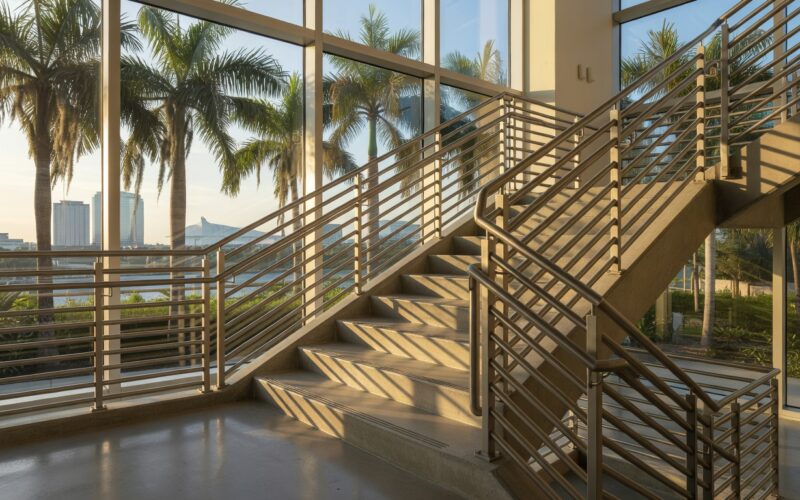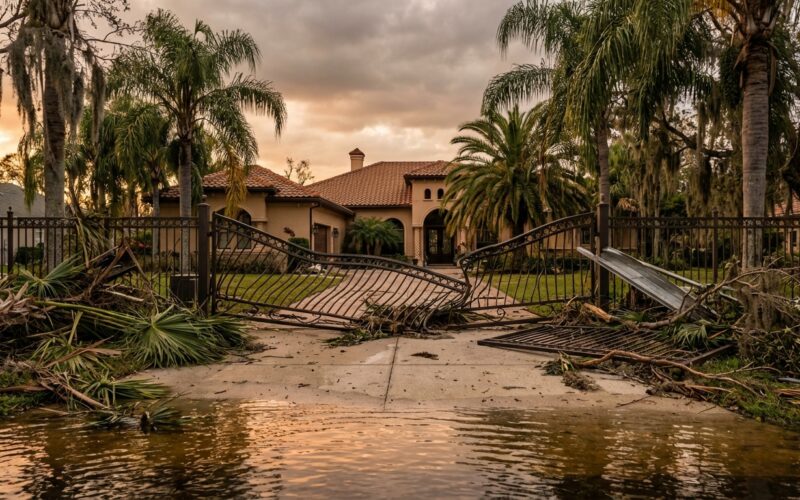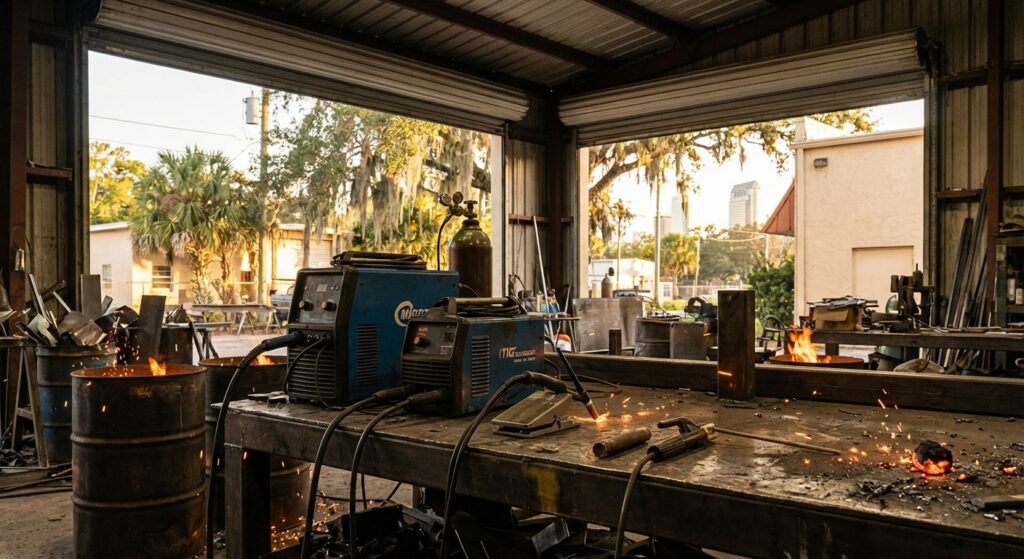
One of the most common questions I get from homeowners in South Tampa, Hyde Park, and Davis Islands is some version of: “What kind of welding are you going to use on my project?” It’s a great question — and honestly, the answer matters more than most people realize. MIG vs TIG welding isn’t just shop talk. The process your welder chooses directly affects the strength, appearance, and longevity of the finished product. After 20+ years running E2E Welding across the Tampa Bay area, I’ve used all three major processes — MIG, TIG, and Stick — and I want to break down exactly what each one does, when we use it, and why it matters for your specific project.
The Three Main Types of Welding: A Plain-Language Overview
Before we dive into comparisons, let me give you a quick orientation. Welding is the process of joining metals by melting them together — but there are several different ways to generate that heat and protect the molten metal while it cools. Each method has trade-offs in speed, precision, portability, and cost.
Think of it like choosing between a nail gun, a hand saw, and a chisel. They all cut or fasten wood — but you’d never use a chisel to frame a house, and you wouldn’t grab a nail gun for fine furniture joinery. Same logic applies here.
MIG Welding (GMAW): The Workhorse of the Shop
MIG stands for Metal Inert Gas, though the technical name is GMAW — Gas Metal Arc Welding. Here’s how it works: a wire electrode feeds continuously through a gun, creating an arc that melts the wire and the base metal simultaneously. A shielding gas (usually a mix of argon and CO₂) flows around the weld to keep oxygen out while the metal cools.
MIG is fast, relatively easy to learn, and produces clean welds with minimal cleanup. It’s our go-to for high-volume production work — think commercial gate fabrication in Channelside, structural brackets for a Westshore office build-out, or custom steel furniture for an Ybor City restaurant.
- Best for: Mild steel, stainless steel, aluminum (with proper setup)
- Speed: High deposition rate — covers ground fast
- Skill level: Most beginner-friendly of the three
- Limitation: Wind-sensitive — the shielding gas blows away outdoors
- Equipment cost in Tampa: $800–$3,000 for a quality setup
💡 Pro Tip: If you’re getting a custom driveway gate or steel railings fabricated in a shop, there’s a good chance MIG is doing the heavy lifting. It’s efficient, consistent, and cost-effective for those kinds of production runs. The key is using the right filler wire and gas mix for your material — especially with stainless in our coastal environment.
TIG Welding (GTAW): Precision Above All Else
TIG stands for Tungsten Inert Gas — technically called GTAW, or Gas Tungsten Arc Welding. Instead of a wire that feeds automatically, the welder holds a non-consumable tungsten electrode in one hand and feeds filler rod manually with the other. Your foot controls the heat via a pedal, like a gas pedal for the arc.
It’s slow. It requires real skill. And it produces the most beautiful, precise welds you’ll ever see. When I’m working on aluminum spiral staircases for a Davis Islands waterfront home, or fabricating stainless steel railings along Bayshore Boulevard that need to hold up against salt air for decades, TIG is what I reach for.
- Best for: Aluminum, thin stainless, exotic metals, cosmetically visible welds
- Speed: Slow — but precision takes time
- Skill level: Expert — both hands and a foot are working simultaneously
- Limitation: Slow production speed, very sensitive to contamination
- Equipment cost in Tampa: $1,500–$5,000 (a Miller Dynasty 300 runs about $4,200)
TIG also produces zero spatter and requires no slag cleanup — the weld bead comes out looking like stacked dimes when done right. For projects where the weld will be visible and unpainted — like a glass-panel railing system in Palma Ceia or a polished aluminum handrail in Hyde Park — TIG is the only real option.
💡 Pro Tip: Tampa Bay’s salt air is brutal on welds. For anything near the water — Bayshore, Davis Islands, Channelside — I strongly recommend TIG welding with 316L stainless filler rod. The extra chromium and molybdenum in 316L provides dramatically better corrosion resistance than standard 304 stainless. Read more about the best materials for outdoor railings in Florida’s salt air to understand why this matters.
Stick Welding (SMAW): The Field Veteran
Stick welding — formally called SMAW, or Shielded Metal Arc Welding — is the oldest of the three and still one of the most useful. Instead of a wire or separate filler rod, you use a coated electrode (the “stick”) that melts as you weld. The coating burns off and creates its own shielding gas and slag layer to protect the weld.
No external gas tank needed. No wire feeder to jam up. Just a machine, some electrodes, and a clamp. That simplicity is exactly why Stick is king for field work and outdoor repairs.
- Best for: Outdoor repairs, rusty or dirty metal, heavy structural steel
- Speed: Medium — slower than MIG but solid deposition
- Skill level: Intermediate — managing arc length takes practice
- Limitation: Produces slag that must be chipped away; not ideal for thin metal
- Equipment cost in Tampa: $400–$2,000 for a capable Stick machine
When our mobile welding team gets called out to a Seminole Heights property to repair a broken fence post, or to a commercial site in Brandon to fix a structural bracket in the middle of a job site — Stick is often what comes off the truck. It handles wind, dirty metal, and tight access situations that would make MIG completely impractical.
Welding Process Comparison: Side by Side
Here’s a quick reference table I use when explaining the options to clients. Keep in mind that real-world projects often involve more than one process — we might MIG the main structure and TIG the visible joints.
| Characteristic | MIG (GMAW) | TIG (GTAW) | Stick (SMAW) |
|---|---|---|---|
| Speed | Fast | Slow | Medium |
| Precision | Good | Excellent | Fair |
| Outdoor Use | Poor | Poor | Excellent |
| Thin Metal | Good | Best | Poor |
| Heavy Steel | Good | Fair | Excellent |
| Aluminum | Possible | Best | No |
| Cleanup Required | Minimal | None | Slag removal |
| Skill Required | Low–Medium | High | Medium |
How Tampa Bay’s Climate Affects the Choice
This is where things get specific to our region — and it’s something a lot of out-of-state welders don’t fully appreciate until they’ve worked here a while.
Tampa Bay’s humidity regularly sits above 80%, and our coastal air carries chloride levels that eat through poorly protected welds in a matter of years. I’ve seen gate welds on Bayshore Boulevard that were done with the wrong process and wrong filler — completely rusted through in under five years. That’s a warranty nightmare and a safety issue.
Here’s how climate factors into our process decisions:
- Salt air exposure: TIG with 316L stainless filler is the gold standard for anything within a mile of the bay
- Wind: MIG and TIG both require wind blocks outdoors — Stick handles wind without issue
- Humidity and Stick electrodes: We store our electrodes in a rod oven per AWS A5.1 guidelines — moisture-absorbed electrodes cause porosity and weak welds
- Hurricane-rated structures: All structural welds on hurricane-resistant buildings must meet Florida Building Code 2023 requirements under AISC 360 and AWS D1.1 — process matters less than certified procedure and inspection
⚠️ Warning: If you’re getting structural welding done on a load-bearing element — a carport, a second-story balcony, a roof attachment point — Florida Building Code Section 1705 requires special inspections on critical welds. This means visual, ultrasonic, or radiographic testing by a qualified inspector. Don’t skip this step. A failed weld on a hurricane-rated structure isn’t just a repair bill — it’s a life-safety issue. Always ask your welder if they’re working to AWS D1.1 procedures.
Real Tampa Bay Projects and Which Process We Used
Let me walk you through a few real-world scenarios from our work across the area. Names are changed, but the details are accurate.
Waterfront Railing Replacement — Davis Islands
A homeowner on Davis Islands needed their corroded aluminum pool railings replaced. The existing mild steel railings had rusted completely through at the base welds — classic salt air damage. We spec’d aluminum tube with TIG welding throughout, using a 4043 aluminum filler rod. Total project: about $2,800 for 40 linear feet of railing. The welds are invisible under the brushed finish, and aluminum won’t rust. That railing will outlast the house.
Commercial Gate Fabrication — Channelside Development
We fabricated a set of dual swing driveway gates for a mixed-use development near Channelside. The gates were 14 feet wide total, built from 2″ square steel tube, with a powder coat finish. This was a MIG job all the way — fast, consistent welds on a production timeline. We ran about 200 linear inches of weld in a single shop day. The developer needed them installed within a week of order. MIG made that timeline possible. TIG would have tripled the labor hours.
Emergency Field Repair — Seminole Heights
A property manager called us after a delivery truck clipped a wrought iron fence post at a Seminole Heights rental property. The post was sheared at grade level, the metal was surface-rusted, and it was a breezy afternoon. This is exactly the scenario Stick welding exists for. Our mobile team was on site within two hours, ground the rust off the base, and had a new post welded in place in about 45 minutes. Total repair cost: $285. You can read more about situations like this in our post on when to call a mobile welder to your location.
What Should You Ask Your Welder?
You don’t need to be a welding engineer to have an informed conversation with your contractor. Here are the questions I’d ask if I were the homeowner:
- What process are you using, and why is it right for my material? — If they can’t explain it in plain language, that’s a red flag.
- What filler metal are you using? — Especially important for stainless and aluminum near the coast.
- Are you working to any AWS or FBC standards? — For structural work, this isn’t optional.
- Will the welds be visible? How will they be finished? — This determines whether TIG precision matters aesthetically.
- Are you certified for this process? — AWS certification isn’t always legally required for residential work, but it tells you the welder has been tested.
A good welder will welcome these questions. We do. Check out our guide on how to choose the right welding company in Tampa for a deeper dive into vetting your contractor.
💡 Pro Tip: Most professional welding shops today use multi-process machines that can switch between MIG, TIG, and Stick. That flexibility means a good welder can choose the right tool for each phase of your project — not just default to whatever they’re most comfortable with. When you’re getting quotes for commercial welding work, ask if the contractor has multi-process capability. It often signals a more experienced, better-equipped operation.
Frequently Asked Questions
Is MIG or TIG welding stronger?
Both processes can produce welds that meet or exceed the base metal’s strength when done correctly. TIG tends to produce cleaner, more precise welds with less risk of porosity on thin or exotic metals. For thick structural steel, MIG is often preferred because the higher deposition rate allows for better penetration on heavy sections. Strength ultimately comes down to the welder’s skill, the correct filler selection, and proper joint preparation — not the process alone.
Why is TIG welding more expensive than MIG?
TIG welding is significantly slower — a skilled TIG welder might take 3–4 times longer to complete the same weld length as MIG. It also requires a higher skill level, which commands higher labor rates. When we quote TIG work, the labor cost reflects both the time and the expertise involved. For cosmetically critical or corrosion-sensitive applications, that premium is absolutely worth it. You can get a sense of typical welding costs in our Tampa welding repair cost guide.
Can you weld aluminum with a MIG welder?
Yes, but it requires a specific setup — a spool gun or push-pull feeder, 100% argon shielding gas, and aluminum wire. Standard MIG setups aren’t configured for aluminum out of the box. TIG is generally preferred for aluminum because it gives the welder more control over heat input, which is critical since aluminum conducts heat rapidly and can warp or burn through quickly. For structural aluminum work — like aluminum spiral staircases — I always recommend TIG.
Which welding process is best for outdoor repairs in Tampa?
Stick welding wins for outdoor field repairs. It doesn’t rely on shielding gas that can blow away in the wind, tolerates surface rust and mill scale better than MIG or TIG, and the equipment is compact enough to bring anywhere. Our mobile welding service relies heavily on Stick for on-site repairs across Tampa Bay. For new outdoor fabrication that will be installed after shop welding, MIG or TIG in a controlled environment is still preferred.
Do I need to specify a welding process when getting a quote?
You don’t need to — that’s our job. What you should specify is your material, the application (structural vs. decorative), whether the weld will be visible, and your environment (coastal, indoor, outdoor). A qualified welder will select the appropriate process based on those factors. If a contractor gives you a quote without asking about any of those details, that’s worth questioning. Check out 5 signs your Tampa property needs professional welding repairs to know when it’s time to call.
The Bottom Line: Process Follows Purpose
After 20 years of welding everything from waterfront railings in Palma Ceia to commercial structural steel in Westshore, here’s what I’ve learned: the best welding process is the one that’s right for your specific material, environment, and finish requirements. There’s no universal answer — and any welder who tells you they only use one process for everything is either under-equipped or not thinking critically about your project.
At E2E Welding, we carry multi-process capability on every job. We MIG when speed and volume demand it, TIG when precision and appearance require it, and Stick when the field conditions call for it. That flexibility is what lets us do right by every client, from a homeowner in Seminole Heights needing a fence repair to a developer in Channelside building out a commercial property.
If you’ve got a project coming up and you’re not sure what you need, reach out. I’m happy to talk through the details and give you a straight answer — no upsell, no jargon. Just honest advice from someone who’s been doing this for two decades in this exact market.
E2E Welding provides professional welding services — MIG, TIG, and Stick — across the Tampa Bay area: Tampa, St. Petersburg, Clearwater, Brandon, Wesley Chapel, Riverview, and surrounding communities. Contact us today for a free project consultation and quote.